Loading...
A smart city is easy to imagine as a collection of technologies: intelligent traffic systems, connected buildings, automated utilities, sensors, data platforms and digitally enabled public services.
But technology alone does not make a city smart.
A city becomes smarter when housing is planned alongside mobility; when commercial districts connect naturally with residential communities; when schools, healthcare and public spaces are accessible rather than added as an afterthought; and when infrastructure is designed around how a city will grow decades from now.
As Oman moves towards 2027, this broader definition of urban intelligence is becoming increasingly relevant.
The Sultanate is entering a period in which urban development is moving beyond individual buildings and standalone real estate projects towards integrated places — developments where infrastructure, investment, sustainability, mobility and quality of life are considered as parts of the same system.
The scale of that transition is already visible.
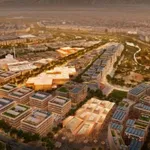
Oman’s Future Cities programme encompasses Sultan Haitham City, A’Thuraya City, Al Khuwair Downtown and Future Salalah City alongside the Greater Muscat Structure Plan. Together, these projects point towards a development philosophy built around mixed-use communities, smarter infrastructure, mobility and long-term metropolitan planning rather than conventional urban expansion.
Perhaps the clearest example is emerging west of Muscat.
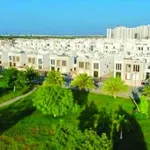
Sultan Haitham City is being developed across 14.8 square kilometres, with approximately 20,000 residential units planned for 100,000 residents, 18 neighbourhoods and around 2.9 million square metres of green space. The total project value is estimated at US$5.2 billion. Its first residents are expected during 2026–2027, while development will continue in phases through 2045.
Those numbers are significant. But what makes the project more interesting is not simply its size.
It is what is being integrated within it.
Schools, healthcare, cultural institutions, places of worship, retail, offices and hospitality are being distributed across neighbourhoods. Walking and cycling networks are being incorporated into the urban fabric. Renewable energy, district cooling, smart mobility and data-enabled city management form part of the infrastructure proposition.
This reflects an important change in how cities are being designed.
For decades, rapid urbanisation across many markets created cities by separation. People lived in one area, worked in another, shopped somewhere else and depended heavily on private vehicles to travel between them. Infrastructure followed development rather than always shaping it.
Integrated urban development attempts to reverse that logic.
Instead of asking how many homes can be constructed on a piece of land, planners increasingly have to ask what kind of community those homes will create.
Can residents walk comfortably to everyday services? Can infrastructure respond efficiently as population density changes? Are public spaces useful throughout the year? Can neighbourhoods support different income groups and generations? Is there sufficient economic activity to prevent residential districts from becoming dormant commuter communities?
And, increasingly, can the city use technology to understand and improve how all these systems perform?
This is where the meaning of the smart city is changing.
The first generation of smart-city thinking often centred on visible technology. The next generation is more subtle. Data becomes valuable not because a city can collect more of it, but because information can improve decisions about energy consumption, water, transport, waste, maintenance, safety and development.
A smart streetlight that reduces unnecessary electricity consumption is useful. A city that understands how mobility, street lighting, pedestrian activity, energy demand and public-space utilisation interact is considerably smarter.
The distinction is important for Oman.
Climate, water availability, mobility patterns and relatively low-density development create urban challenges that cannot simply be addressed by importing models developed elsewhere. The city of the future in Oman must respond to its own environment.
Shade matters. Building orientation matters. Water efficiency matters. The distance between homes and essential services matters. So does the ability to create public spaces that remain usable in a hot climate.
Technology should strengthen those design decisions rather than compensate for poor planning.
This philosophy can also be seen beyond Muscat. Future Salalah City is being positioned around climate-responsive development, pedestrian movement, public transport, environmental protection and the distinctive natural and cultural characteristics of Dhofar. The ambition is not simply to reproduce another Gulf development model, but to build around Salalah's particular coastal environment, landscape and economic strengths.
That points towards another important development principle for 2027: smart cities do not have to look the same.
Muscat, Salalah, Sohar and Nizwa perform different economic and social functions. Their climates, industries, populations and development pressures are different. Integrated planning therefore requires cities to become more connected technologically while remaining responsive locally.
Oman’s National Spatial Strategy provides the wider framework for this approach, coordinating urban, infrastructure and economic development across all 11 governorates over a 20-year horizon. Its significance lies in recognising that urban development cannot be separated from decisions about transport, investment, environmental protection and economic activity.
The investment implications are considerable.
Integrated development creates opportunities far beyond residential construction. It requires mobility systems, utilities, district cooling, digital infrastructure, landscaping, public realm, energy solutions, building technologies, engineering, architecture, facilities management and increasingly sophisticated systems for operating cities after construction is completed.
Oman's existing integrated residential neighbourhood programme offers an indication of that scale. The Sorouh initiative includes 18 integrated residential projects covering more than six million square metres, with over 9,950 housing units and investment exceeding OMR 500 million.
Urban development is therefore becoming not simply a real estate story, but an increasingly interconnected economic ecosystem.
That creates a challenge for the construction and development industry as well.
The industry traditionally thinks in terms of projects with defined beginnings and endings: design, build and hand over. Smart urban development requires a longer perspective. Buildings will increasingly need to interact with energy networks, mobility systems, digital platforms and surrounding public infrastructure throughout their operating lives.
The value of a development may consequently depend as much on how intelligently it operates as on how efficiently it was constructed.
By 2027, this may become one of the most important shifts facing the built environment sector.
The conversation will move from individual smart buildings towards connected districts; from individual developments towards integrated communities; and from installing technology towards using technology to improve the everyday experience of a city.
It also changes what success looks like.
The smartest city will not necessarily be the one with the greatest number of sensors or the most futuristic skyline. It may instead be the city where a resident spends less time in traffic, where water and energy are consumed more efficiently, where public spaces encourage people to interact, where infrastructure anticipates growth and where digital systems quietly make everyday life easier.
Oman is now building at a moment when many of these choices can still be made at the planning stage.
That is an advantage.
Retrofitting fragmented cities is difficult and expensive. Designing integration from the beginning creates the opportunity to think simultaneously about buildings, infrastructure, landscape, mobility, technology and community.
As the Sultanate's next generation of cities begins to take physical shape, the defining question is therefore unlikely to be simply how much Oman builds.
It will be how well everything Oman builds connects.
And that may ultimately be what makes a city truly smart.